Why a women-focused home gym guide helps
Women do not need separate or weaker versions of fitness equipment. A barbell, adjustable bench, cable machine, dumbbell, treadmill, or resistance band works according to its design, not the gender of the person using it. Still, a useful guide for women should address practical issues that affect many female lifters: limited space, training confidence, privacy, adjustable sizing, support, comfort, budget, pregnancy or postpartum considerations, and the desire to build strength without buying a room full of equipment.
The best home gym is not the one with the most machines. It is the setup that makes your preferred training easier to repeat. If you enjoy strength training, prioritize equipment that supports progressive resistance. If you prefer low-impact cardio, prioritize a machine you will actually use. If your schedule is unpredictable, choose compact equipment that can be stored quickly.
This article is general fitness information. It is not medical advice. Anyone returning after injury, managing a chronic condition, pregnant or recently postpartum, or experiencing pain should seek guidance from a qualified healthcare professional.
Start with the room, not the shopping cart
Measure the room before buying anything. Record ceiling height, floor dimensions, door width, stair access, wall clearance, ventilation, outlets, and the location of windows or low beams. A rack that fits on paper may be unusable if the bar hits a wall or the ceiling is too low for pull-ups.
Create three zones: a training zone, a storage zone, and a clear walking zone. The training zone needs room for a bench, a barbell, or a mat. The storage zone keeps plates, dumbbells, bands, and accessories off the floor. The walking zone protects you from tripping while carrying weight.
Consider noise and flooring. Apartment residents may need low-impact equipment and a surface that reduces vibration. Garage users should check temperature, moisture, and the load capacity of the floor. A thin yoga mat is not a complete solution for dropping weights. Use equipment and flooring suited to the movements you perform.
The essential equipment tiers
Tier one: a complete low-cost foundation
A useful starter setup can be built around adjustable dumbbells, a stable bench, resistance bands, a mat, a jump rope or low-impact cardio option, and a storage solution. This combination supports squats, split squats, rows, presses, deadlifts, hip thrusts, carries, curls, and many core exercises.
Adjustable dumbbells save space and money, but inspect the locking mechanism and handle comfort. Fixed dumbbells are faster to use and often more durable, but a full set requires more room. Choose a weight range that allows you to progress on lower-body movements while still performing upper-body exercises with control.
A bench should not wobble. Check its height, pad width, weight capacity, adjustment positions, and storage footprint. The stated capacity should include the user and the load. For a small space, a foldable bench may be practical, but it should remain stable when opened and locked.
Tier two: a serious strength setup
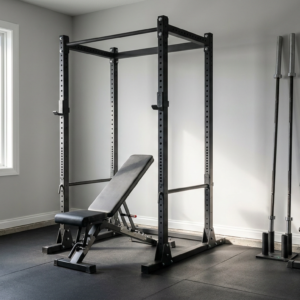
Add a barbell, plates, a power rack or squat stand, collars, and suitable flooring. A power rack provides more exercise options and can support safer solo training when used correctly. A squat stand is more compact and may suit people who need portability or have a smaller room.
Compare rack height, depth, upright size, hole spacing, safety arms or straps, pull-up options, attachment compatibility, anchoring instructions, and warranty. Do not buy a rack without measuring the ceiling and the bar path. If you train alone, a reliable safety system matters more than a dramatic product photo.
Choose plates based on your lifts and storage. Bumper plates can be useful for controlled Olympic-lifting practice but may take more space. Iron plates are often thinner and economical but require appropriate flooring and careful handling. Store plates where they cannot roll into the walking path.
Tier three: a versatile home training room
Once the foundation is consistent, consider a functional trainer, cable tower, specialty bar, adjustable kettlebell, cardio machine, or dedicated storage. Additions should solve a real limitation. A cable system can improve exercise variety, but it requires clearance and maintenance. A treadmill can be valuable for walking, but it is a poor purchase if you dislike indoor walking or have nowhere to place it.
A functional trainer is often more versatile than a single-purpose machine, but compare the cable ratio, weight stack, height, width, attachment options, and service support. If a machine is difficult to access, it will not improve your routine.
Best equipment by common training goal
Building strength
Prioritize adjustable dumbbells or a barbell, a stable bench, a rack or stands, plates, collars, and flooring. Add pull-up assistance or a cable attachment if upper-body pulling is a goal. Track load, repetitions, sets, and technique so you can progress gradually.
Glute and lower-body training
Lower-body training does not require a single “glute machine.” Squats, split squats, deadlifts, hip thrusts, step-ups, lunges, and cable movements can all be useful. A bench that supports hip thrusts, dumbbells, a barbell, plates, a resistance band, and a non-slip surface may be enough.
Choose equipment based on alignment and stability rather than a promise to target one body part. No tool can spot-reduce fat from a particular area. Muscle development comes from consistent resistance training, adequate recovery, and appropriate nutrition.
Low-impact cardio
Options include walking, cycling, rowing, elliptical training, and dance-based workouts. A machine should match your joints, space, noise tolerance, and preferred intensity. Start at a manageable level and build duration gradually. If a machine causes pain, stop and get advice rather than forcing the movement.
Mobility and recovery
A mat, foam roller, light resistance bands, yoga blocks, and a small mobility area can support warm-ups and recovery work. Recovery tools should not replace sleep, adequate food, and sensible training volume. A hard roller is not automatically better, and discomfort should not be treated as proof of effectiveness.
Equipment fit and comfort
Equipment design affects confidence. Dumbbell handles should fit your grip. Bench pads should provide support without forcing an awkward shoulder position. Cable attachments should be comfortable through the full range of motion. A rack should allow you to set the bar at a position that suits your height and movement.
Women with smaller hands may prefer bars with a suitable diameter and knurling. Beginners may prefer lighter technique bars or adjustable equipment that makes loading simple. There is no prize for choosing the heaviest equipment you cannot control.
For cardio, check stride length, step height, seat adjustment, handle position, and screen visibility. For clothing and footwear, choose items that allow movement without distracting seams, slipping waistbands, or inadequate support.
Safety at home
Secure heavy racks according to manufacturer instructions. Keep cords away from walking paths. Lock adjustable dumbbells before lifting. Use collars on bars. Test benches and attachments before loading them. Keep children and pets away during training and storage.
When training alone, use safeties, choose loads you can control, avoid reckless max attempts, and keep a phone accessible. A mirror can help with positioning, but it should not replace coaching or attention to technique.
Warm up with movements that prepare the joints and muscles for the session. Start light, practice the range of motion, and increase the load only when form remains controlled. Sharp pain, numbness, unusual weakness, dizziness, or chest symptoms are reasons to stop and seek appropriate care.
How to budget without wasting money
Divide your budget into equipment, flooring, storage, delivery, maintenance, and contingency. A low-cost setup that lacks collars, safe flooring, or storage is not truly low cost. Look at total ownership cost, including assembly, returns, replacement parts, and warranty support.
Buy used equipment carefully. Inspect welds, bolts, cables, bearings, padding, and rust. Confirm that replacement parts are available. Avoid used safety equipment with unknown damage or missing hardware.
Do not buy every accessory in the first week. Start with a training plan and add equipment after you discover a real need. A resistance band that sits in a drawer is not a bargain.
A sample progressive setup
Month one can focus on adjustable dumbbells, a bench, bands, a mat, and storage. Month two can add more weight or a better bench if you are using the first setup consistently. Month three can add a rack, barbell, and plates if your training goals justify it. Later, consider cables or cardio equipment.
This staged approach reduces impulse purchases and helps you learn what you enjoy. It also creates a safer progression from basic movements to heavier loading.
Frequently asked questions
What is the best home gym equipment for women?
The best equipment is the equipment that matches your goal, space, budget, and experience. For many beginners, adjustable dumbbells, a stable bench, resistance bands, a mat, and storage form a useful foundation.
Do women need special gym equipment?
No. Women can use the same well-designed strength and cardio equipment as anyone else. Fit, adjustability, comfort, and safety matter more than gender-specific colors or marketing.
Is a home gym worth the cost?
It can be worthwhile if it removes barriers and helps you train consistently. Compare the total cost with your expected use, available space, and alternatives such as a gym membership or community facility.
Can I build muscle with home equipment?
Yes, muscle can be built with progressive resistance training using dumbbells, barbells, bands, cables, or machines. The key is consistent training, adequate recovery, and nutrition that supports your goal.
What equipment should a beginner avoid?
Avoid unstable, poorly documented, or incompatible equipment, as well as products bought only because a headline promises fast body changes. Verify dimensions, load ratings, safety features, warranty, and return policy.
Final checklist
Measure the room, define your training goal, buy a stable foundation, plan storage and flooring, verify load ratings and compatibility, follow installation instructions, progress gradually, and add equipment only when your routine proves you need it.